
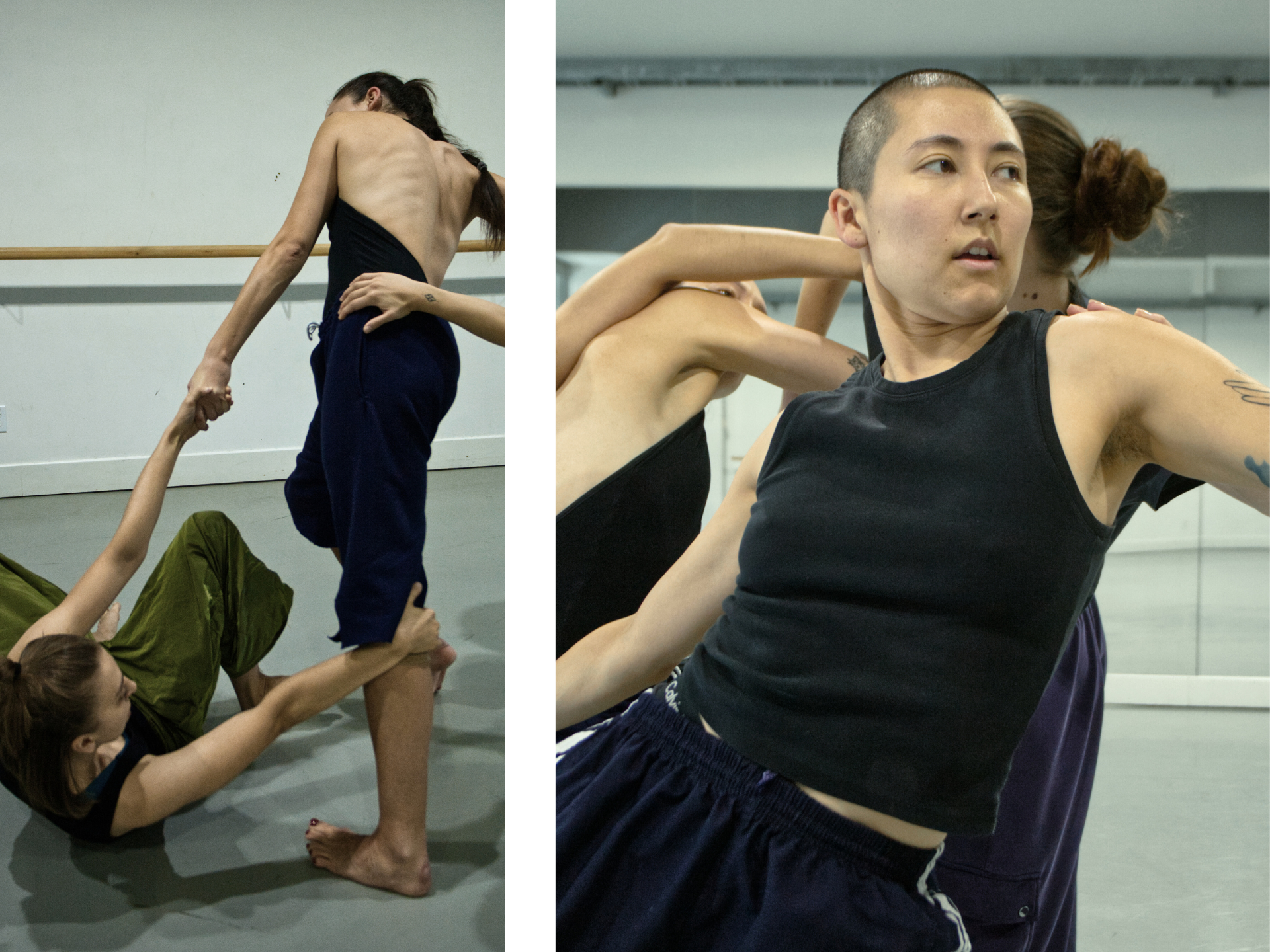
photo by Jon Mcrea
FUTURE ALTERNATES
SIMONA DEACONESCU, VANESSA GOODMAN
OVERVIEW
Romanian-Canadian duet Simona Deaconescu/Vanessa Goodman met in Montreal in 2019 and developed a strong artistic bond. Despite living on different continents, the two dance artists began collaborating on their first project, BLOT—Body Line of Thought. Even during the height of pandemic restrictions, they found ways to meet in secluded residencies across Europe and Canada to create a piece exploring our porous microbial identity.
BLOT became a manifesto for contamination and impurity at a time when the human body was increasingly treated as sterile. The temporary halt of festivals offered them the space to refine their shared discourse, merge their practices—alongside their bacterial colonies—and develop a common language and working methodology.
They premiered the piece in 2021 as an installation at the 13th Dance Biennale in Vancouver, later reworking it for the stage with two young performers, Simona Dabija and Maria Luiza Dimulescu. Since 2022, the stage version of BLOT has been presented at dozens of festivals across Europe and North America, including selections in international exposure showcases as internationale tanzmesse (2024) and Moving Balkans (2025).
If BLOT examines the microbiome and its invisible negotiations of identity, Future Alternates moves inward—toward the bone and its marrow—as sites of speculative evolution, where the body’s internal architecture becomes a terrain of transformation, pressure, and reorganization under shifting gravitational and social forces.
We are losing the ground we have stood on for so many decades. The tectonic plates of meaning, power, and gravity are shifting beneath our feet, destabilizing the architectures that once sustained collective life. Change appears as both radical and necessary — yet it often arrives as the radicalization of dysfunction, of oppressive systems that refuse to decompose. Future Alternates begins here: in the interval where adaptation becomes resistance.
The project approaches the bone marrow as a speculative organ of the future — one that is no longer hidden within the skeleton but exposed, porous, and communicative, like an armour turned inside out. The marrow becomes a site where biological, social, and planetary transformations intersect: a field of vibration, regeneration, and pressure.
This new group piece brings together dancers from Canada and Romania, as well as the immersive electronic music of loscil (Scott Morgan). Future Alternates has received the Chrystal Dance Prize from Dance Victoria and includes a confirmed residency at La Briqueterie (FR) in July 2026.
The Scotiabank Dance Centre in Vancouver (CA) is supporting a two-phase collaboration: an initial movement research residency in October 2025, followed by a production period and Canadian premiere in April 2027 as part of their Global Dance Series. The piece is currently in its early development phase, supported by a research grant from the Canada Council for the Arts.
CONCEPT
TOWARD A MINERAL EMBODIMENT
Evolutionary biology tells us that bones first appeared as odontodes — tiny mineral formations on the skin of early vertebrates that hardened into scales and teeth. Over millions of years, this external armour moved inward, becoming living tissue that could store minerals, generate energy, and allow mobility. What was once protection became metabolism; what was once exterior became interior.
In Future Alternates, this evolutionary inversion becomes a lens for understanding how both biological and social bodies transform. We are interested in how societies internalize their defences, how both oppression and liberation become part of their metabolism, and how, at certain moments, those defences turn outward again — visible, audible, and collectively activated.
Bone, in this context, is not a symbol of rigidity but of adaptation. It constantly rebuilds itself, responding to gravity and pressure. Every bone is a geological memory of movement — a living mineral structure that stores traces of environment, trauma, and resilience. Future Alternates extends this idea toward the bone marrow, understood as tomorrow’s organ — a porous, exposed interface where internal vibration and external gravity meet. If the skeleton once served to hold us upright, the marrow now becomes a site of sensing and reorganization. It is imagined as an armour turned inside out, a soft infrastructure of regeneration and resistance.
Drawing from posthuman philosophy, Future Alternates treats the body as part of a broader ecology of matter — one that includes minerals, sound, technology, and gravity. The piece reimagines the human skeleton not as a structure of permanence but as a living system capable of continuous transformation. It invites audiences to sense the body as a site of geological memory and future potential — where bone, marrow, and movement co-evolve in response to a planet that no longer stands still.
Future Alternates imagines a future Earth where atmospheric instability has altered gravity itself, forcing the human skeleton to reorganize — its bones reforming under new gravitational laws. How would altered gravitational load reshape bone density and marrow production, changing the body’s capacity to regenerate and sustain itself? And if gravity is rewritten at a planetary scale, what new thresholds of adaptation — biological, technological, or social — would define what we still call human?
The project takes these physiological facts as compositional tools. The dancers explore how gravity can be changed perceptually — through counter-forces, vibratory frequencies through overtone singing, redistribution of weight, propulsion and internal inflation.
As bone density and proprioception are tied to gravity, these experiments imagine the future skeleton as a mutable system: bones of the face, skull, and spine resonating as air passes through; bone marrow migrating metaphorically toward the surface as a porous armour. Microgravity, in this sense, is not absence but transformation — a condition through which the dancers perform new internal mechanics, extending the body’s capacity to reorganize movement, perception, and the mineral intelligence of its own structure. The body becomes a tectonic field of micro-adjustments, constantly rebalancing like tectonic plates under pressure.
CREATIVE DUO
SIMONA DEACONESCU & VANESSA GOODMAN
Simona Deaconescu (RO) and Vanessa Goodman (CA) are working across performance, installation, and film, exploring how bodies adapt to the social, ecological, and technological systems that shape them. Their collaboration bridges two artistic ecosystems — Eastern Europe and the Pacific Northwest — and reflects a shared commitment to research-based, interdisciplinary creation.
Simona’s work examines social constructs and the politics of the body, often blurring the boundaries between documentary and fiction. Her projects unfold in dialogue with history, technology, and collective memory, expanding choreography beyond the limits of the human form.
Vanessa’s choreographic practice investigates the relationship between the body, sound, and environment, using generative systems and sonic propositions to build immersive performative landscapes. She respectfully acknowledges that she lives, works, and creates on the stolen ancestral and unceded territories of the Coast Salish peoples.
Each artist brings a unique voice to their shared work, with practices that have been presented and supported internationally.
Simona is a two-time Aerowaves Artist (2018, 2022), Moving Balkans Artist (2025), and recipient of the National Centre for Dance Bucharest Award (2015). In the past years, she has developed her productions within international networks such as MODINA, Biofriction, and Forecast, presenting work across Europe, Canada, Mexico, and South Africa.
Vanessa has received the Iris Garland Emerging Choreographer Award (2013), the Schultz Endowment (Banff Centre 2019), The Isadora Award (2025) and the Chrystal Dance Prize (2018/19 & 2024/25). She is currently engaged in a three-year artist-in-residence position with The Dance Centre in Vancouver. Her commissioned works include creations for Ballet BC, Votive Dance, and professional programs such as Springboard Dansé Montréal, Lamondance, Modus Operandi, and Simon Fraser University.
BLOT—Body Line of Thought, the work that brought them together has toured across Europe, North America, and Latin America, with over thirty presentations to date across fifteen countries. Praised for its precision and conceptual clarity — described by Marta Bugio (New Dramaturgies Magazine) as “the most emblematic performance of the 2023 edition of Antistatic… a hypnotic dance where nudity becomes a scientific necessity,” and by Marína Srnka (Springback Magazine) as “a quiet, destabilising awareness that to be human is to be plural.”